Sunday, April 4, 2021

Renewable Energy, a revisit


April 4, 2021 | 10:35 pm

Introspective by Romeo L. Bernardo


PCH.VECTOR/ FREEPIK


(First of two parts)

In my column a decade ago, “Renewable energy – reality check” (https://www.fef.org.ph/fef/renewable-energy-reality-check/) I chided the private proponents of new renewable energy (RE) technologies (solar, wind, and biomass), the National Renewable Energy Board (NREB), and multilateral institutions for pushing an expensive Feed in Tariff (FIT) program on the Philippines on the grounds that we need to do this as our contribution to averting a climate change catastrophe. This notwithstanding our global carbon emission contribution being a rounding error (0.3 of 1%), and our RE mix then at 42% of total power generation capacity, is four times the global average.

I noted in my article then that this would have burdened us with 20-year supply contracts with power costs that were equivalent to P10 to P25 per kWh, twice to five times avoided cost. This is not even counting the cost of ancillary power standby to cover for RE intermittency (when there is no wind or when it is cloudy) and their needed transmission and distribution infrastructure.

Thanks to the advocacy on behalf of consumers and taxpayers by the Foundation for Economic Freedom, the PCCI, and the wise intervention of then-Senate Energy Committee Chair Serge Osmena, the final FIT rates were negotiated down substantially.

Fast forward 10 years to today, and we find that just counting the direct cost of FIT subsidy payments to RE providers now runs at P20 billion annually. For perspective, this is the equivalent to conditional cash transfer social assistance for 10 million poorest people in 2019, and is around the annual budgets of each of the following executive departments: Environment and Natural Resources, Finance, Foreign Affairs, Justice, and Science and Technology. And P20 billion is an annual number; for the long run cost, multiply this by 20 years, the contract period.

Since then the prices for solar, especially of solar panels, have dropped; is it now time to embrace them unqualifiedly? And should government mandate them through quotas like Renewable Portfolio Standards (RPS), excise taxes like the recent coal tax insertions in TRAIN 1 (see my column https://www.bworldonline.com/gravy-train-leaving-common-sense-isnt/), or restrictions on building new fossil plants?

Consider: if indeed the drop in RE prices and technology improvements now make them commercially competitive with fossil fuels as contended by their champions, there should be no need for more subsidies, direct or hidden: No FIT, no quotas and no taxes and bans on coal. (Riding on this lobby are the advocates of natural gas, passing it off as green and renewable, even while gas has half the carbon footprint of coal, and is not renewable.)

Precisely because such non-technology neutral government interventions are an override on market competition, they have the effect of raising the cost of power, particularly immiserating for a country like the Philippines that has yet to develop a manufacturing base to absorb the millions of jobless. Manufacturing requires base load plants which today, setting aside controversial nuclear plants, can only be driven by fossil fuels.

How high is that cost burden now? To illustrate further, compare the current FIT rates for solar and wind of P8 to P10 per kWh for 20 years versus the competitively bidded cost of P4.15/P4.26 per kwh in the recent CSP bidding of Meralco. (“SMC units submit lowest bids for 1,800 MW Meralco supply deal,” Feb. 20).

And what have we got to show for this heavy cost? Very little. This conclusion is validated by a study of Dr. Josef Yap, “Evaluating the Feed-in Tariff Policy in the Philippines” (https://papers.ssrn.com/sol3/papers.cfm?abstract_id=3520401) that even with energy subsidized through the FIT, end users still face a net higher cost, despite this so-called merit order effect of RE. (Any power supply contract with lower marginal cost than peaking plants will have identical effect, and is not unique to RE).

Moreover, solar and wind generation together only account for 2.4% of total generation. The bulk of our RE still comes from traditional renewables, hydro and geothermal (20%) that do not enjoy, nor lobby for, such subsidies or quota mandates.

This heavy public cost of supporting such expensive RE is mirrored at the global level in states and countries that embraced such policies versus those who didn’t.

Electricity prices in RE-supportive California rose five times more than the rest of the US. German electricity prices rose 51% from 2006-2018, and now stands at twice the level of France which is mostly nuclear powered. In Fact, Germany now depends on France to stabilize their RE-heavy and thus unstable grid.

Don’t get me wrong about RE. It has a role in energy provision for the Philippines – it already does! But poorly designed public policies to promote RE can have damaging effects on how our energy markets work, and that has led to higher prices for Filipinos, poor use of public funds, and misinformation about the necessary role thermal energy has in powering this country’s economy. If the government wants to play a role, just be sure to do so only where it is needed, and follow the Hippocratic oath of our caring doctors and nurses when designing public policy: “Do no harm”

Climate Change Adaptation Vs Mitigation

On the point about “only where it is needed” let’s consider adaptation versus mitigation, and what makes sense for the Philippines. In Paris in 2015, the Aquino administration committed our country to reduce our greenhouse gas emissions by 70% by 2030, an ambitious, costly and unrealistic target. The Climate Change Commission said the country needs to spend $12 billion to $15 billion, or P584 billion to P730 billion, to reduce up to 70% of its emissions. A staggeringly large number equivalent to 3.25% to 4% of our GDP.

This likely does not even fully reflect the higher cost of power and the cost of managing intermittency discussed earlier. And as I argued, THIS yields very little for the country and our people. (Maybe except green bragging rights? But that is like asking a poor man to wear an Armani suit which he cannot afford and which is inappropriate for his tropical climate just so he can look fashionable in the eyes of the world.)

I have been following the FaceBook page of Finance Secretary Sonny Dominguez, newly designated chairman of the Climate Change Commission. An astute fiscal manager of our country’s scarce resources who deeply cares for our people, he quickly pivoted away from the climate change mitigation chorus and into grounded actionable climate change adaptation programs.

And I quote:

“Why does the Philippines focus more on climate adaptation rather than mitigation?

“Despite the Philippines being one of the lowest contributors to global GreenHouse Gas Emissions (GHGs) at around 0.3%, we are still one of the most vulnerable countries to the effects of climate change.

“This is why our climate action efforts focus more on climate adaptation rather than mitigation. We need to adapt and be prepared for the harmful effects of natural disasters (e.g., typhoons, drought, rising ocean temperatures, etc.) brought about by climate change.” ( Source: Department of Finance FaceBook page .)

Amen!

The Climate Change Commission may have reaffirmed, even strengthened, its 2015 commitments, perhaps before Secretary Dominguez assumed its chairmanship. My appeal: please review and align with your most recent sound pronouncements, Secretary Sonny?

(Part 2 of this column will discuss the energy trilemma, the need to balance energy security, energy equity/affordability, and energy sustainability using the World Economic Forum framework, regulatory philosophy and practice under EPIRA, and a suggested RE transition roadmap for the Philippines).

Romeo L. Bernardo was finance undersecretary during the Cory Aquino and Fidel Ramos Administrations. He is currently GlobalSource Partners Philippine Adviser (globalsourcepartners.com). He is also an independent director in the largest renewable energy company in the Philippines.


Wednesday, March 3, 2021

Slow crawl out of the trenches

Introspective


SOURCE: PSA


SOURCE: GOOGLE


*SIZE OF BUBBLE PROPORTIONAL TO SECTOR SHARE TO GDP IN 2020 SOURCE: PSA


Gross domestic product (GDP) contracted 9.5% last year, with the 15% fall in consumption and investments only partly offset by government spending and a significant narrowing of the trade deficit, itself a reflection of the demand collapse. Quarterly data show that as lockdown measures were gradually relaxed and mobility increased, there was a rebound in activity in Q3, in part reflecting pent-up demand, that softened in Q4. The gains notwithstanding, the level of Q4 2020 output was still 8% lower than Q4 2019. Expectations now of sustaining growth hinge on keeping infections down even as quarantine restrictions are progressively loosened.

Consensus forecast shows expectations of a sharp rebound in 2021 economic growth that is close to the upper end of the government’s 6.5-7.5% GDP growth target. Multilateral agencies on the other hand projects economic growth nearer the lower end of the range, with the World Bank forecasting it to fall slightly below 6%. Our outlook is still less upbeat, with GDP growing 5.5% this year. This is slightly up from the 5% projection in our report in early December, due mainly to expectations of stronger global economic recovery following the roll-out of several vaccines. This is positive news for the export sector, particularly with the forecast upturn in the electronics cycle, as well as for BPOs, a job creating sector.

Nevertheless, the overall outlook for domestic demand is still a grim one, reflecting both institutional/governance issues as well as the pandemic’s uneven impact on sectors and income groups that will weigh on recovery prospects. More specifically:

1. Government’s vaccine procurement program has encountered one problem after another such that following the current schedule that already reflects private sector assistance, major deliveries of vaccines (30-50 million doses) will only happen in Q3 and Q4. A serious vaccination effort could thus only start thereafter which will be a slow process considering logistical challenges in distribution and the high proportion of Filipinos who, surveys say, are not willing to get vaccinated. Even without considering the latter, experts tell us that herd immunity, i.e., 50 million adults getting the jab, will happen only by Q4 of 2022.

2.  Given the above, capacity restrictions due to physical distancing requirements as well as mobility restrictions to protect the vulnerable will remain in place. Although economic managers appear to be doing their utmost to persuade decision makers to balance risks from COVID-19 (coronavirus disease 2019) against those from hunger, poverty, unemployment, and income losses, they not only face opposition from their counterparts in the health sector but also state security forces and, more so lately, risk-averse local government officials. Google mobility data so far this year are reflective of restrictions in place, with activities still well below pre-pandemic levels, especially for public transport that has a 50% capacity limit. The President’s reluctance to shift to a more relaxed quarantine level without a mass vaccination program in place necessarily caps near term growth potential, something that economic managers recognize as well.

3.  Apart from general restrictions, a more specific problem has to do with the fragmented COVID-19 guidelines issued by local governments that makes inter-provincial/city travel difficult and costly. The problem affects both movement of workers and recovery of domestic tourism, seen as an important interim solution for closing some of the demand gap. The tourism industry not only has high linkages with the rest of the economy (the sector’s direct and indirect contribution to output is estimated at 12.7% of GDP in 2019) and employment potential (13.5% of total in 2019), but benefits significantly from domestic travelers (85% of total gross value added), a prospective growth area considering pent up demand from higher income groups for leisure activities. Aviation sector experts report that Philippine passenger volumes by late last year were only around 20% of pre-pandemic levels, lagging behind neighboring economies where the gaps have closed more significantly.

4. Aside from the above government-related constraints, the recovery will be marked by unevenness in spending where recoveries in discretionary spending of those who have managed to preserve jobs and incomes and accumulate savings under lockdown are dragged by expenditure cutbacks and scrimping on the part of those who have suffered job loss and wage cuts. Unfortunately, job and wage cuts are continuing per the labor department’s January report, even as survey data last quarter already showed worrying signs of discouraged job seekers and reduced work quality, i.e., more of the employed working less hours, and in less formal, lower skilled/wage occupations. Elevated food inflation lately is expected to lead to more scrimping.

5. At the firm level, recovery prospects are also highly uneven as may be seen in Q4 production accounts where outputs of 43 out of 60 non-agricultural sectors were still below pre-pandemic levels. With excess capacities running from industrial (manufacturing and construction) to services (real estate, close contact sectors) and firms grappling not just with profitability issues but with the timing of cash inflows to cover fixed overhead costs, including interest payments on debts, business expansions will be limited especially given the runup in the private sector’s capital expenditures pre-pandemic. These lagging sectors will drag expected expansions in sectors that went through the pandemic relatively unscathed, especially telecommunications where continuing large capital expenditures are required to meet rising demand. Although there would be similar motivations for investments in utilities, e.g., water, power, toll roads, we expect more restraint given the approaching elections and increased regulatory risks.

6. The damage to households’ and firms’ balance sheets will in turn hurt the financial sector’s asset quality and dampen their lending appetites, a drag to monetary policy effectiveness. The extent of the damage will only play out over time as moratoria imposed by law and regulatory forbearance measures are lifted. Current expectations are that non-performing loans (NPLs) of the big banks will double from the end-2020 ratio of 3.1% of total loans, with consumer loan portfolios expected to register larger credit losses. Small and mid-sized banks with larger credit exposure to households and small and medium enterprises can also expect more significant increases in their NPLs. Systemic risks are, however, low considering the dominance of well-capitalized universal and commercial banks (17% capital adequacy ratio as of Sept. 20).

7. Given expected weak demand, the main burden of jumpstarting economic growth still falls on the government. With the stimulative impact of low interest rates running into banks’ risk aversion and the need lately to anchor inflation expectations, fiscal policy will need to do the heavy lifting hereon. Despite relatively moderate new budget resources for 2021, the economy could still prospectively benefit from an additional 1% of GDP of spending authority carried over from last year’s regular and supplemental budgets. However, the worry is still execution risk and government again underspending at a time when it needs to spend as much as it has on hand. The hope now is that early implementation of infrastructure projects to take advantage of the dry season could help to crowd in earlier any associated private investments. Considering, too, political pressure as the election nears that may overcome fiscal authorities’ resistance, another fiscal stimulus package may be passed later in the year, a potential upside to our forecast.

Our 2022 GDP outlook, tentatively at 5%, is clouded by the uncertainties surrounding this year’s forecast, particularly progress in vaccination efforts and effectiveness in disease control that affect confidence all around. The outlook also depends on the electoral process and election outcomes, vaccine efficacy vs. virus mutations, and the impact on global economic recoveries, as well as timing of any withdrawal of accommodative macroeconomic policies globally and locally.

Excerpted from a 20-page report dated Feb. 25, of the same title written by Christine G. Tang and the columnist, Romeo L. Bernardo, for GlobalSource Partners (globalsourcepartners.com) where they are the Philippine Advisors/Partners. GlobalSource Partners is a New York-based network of independent analysts in emerging markets serving mostly fund managers and global banks.


Romeo L. Bernardo was finance undersecretary during the Cory Aquino and Fidel Ramos administrations.

romeo.lopez.bernardo@gmail.com


Monday, January 25, 2021

Data watch: Gross international reserves


January 24, 2021 | 6:37 pm

Introspective By Romeo L. Bernardo


SOURCE OF DATA: BSP


SOURCE OF DATA: BSP, IMF


SOURCE OF DATA: BSP

Last year, gross international reserves (GIR) surged 25% to end the year at close to $110 billion. This is remarkable considering the unprecedented global scale and severity of the COVID-19 crisis.

While short-term capital exited emerging markets as in past crises, this time around in the Philippines, the balance of payments (BoP) remained in surplus and even ballooned to nearly $12 billion in the year to November. The latter mainly reflects collapsed imports as the economy went into recession and, as tax revenues buckled, increased government borrowings with the overall external debt estimated to have risen by around $10 billion last year.

In an interview with the editor of the country’s leading business paper last week, BSP Governor Benjamin Diokno highlighted this atypical but positive upshot of the crisis that kept depreciation pressure off the peso and allowed monetary authorities to aggressively cut policy interest rates. He added that he expects the GIR to continue growing this year, possibly reaching $120 billion.

OUR VIEW
Pre-pandemic, the Philippines already had one of the highest foreign exchange stockpiles based on the IMF’s assessment of reserve adequacy (ARA). The ratio of reserves to ARA at end-2019 was at 2, higher than the 1-1.5 ratio considered adequate and above most countries’ reported ratios. Last year, the additional reserve buildup unarguably gave economic managers more wiggle room to manage the crisis, not least by helping to anchor the sovereign’s credit rating and giving the government continuing access to international capital markets at relatively tight borrowing spreads. By the end of 2020, GIR could amply cover over 5.4x short-term debt plus principal payments on medium to long term loans due in the next 12 months, up from 3.9x at the end of 2019.


Going by this, the GIR will continue to amply cushion any external shock in the near term. Moreover, given our dimmer view of the economy’s growth prospects, we think the current account will still register a modest surplus this year with moderate import growth, while private capital outflows are unlikely to be as massive as last year, with portfolio flows starting to return in 4Q20. We note too that although GIR was in large part boosted by increased government borrowings, these consisted of long-term loans, a significant portion of which is owed to official creditors who also provided long grace periods on principal repayment. One downside risk given BSP’s (Bangko Sentral ng Pilipinas) decision last year to actively trade its gold holdings, is lower gold prices.

However, holding excess reserves is not without cost. From a consolidated public sector viewpoint, the collateral value of these highly liquid assets needs to be weighed against the negative carry associated with their low returns as well as foregone productivity-enhancing domestic public investments. As pandemic risks subside with improved health management and the promise of vaccination, one could argue that keeping such high precautionary cash is no longer warranted.

Too, with the peso having appreciated by 5% in real, trade-weighted terms last year, many in policy circles would argue for a more proactive government response to support the export sector. Realizing that the BSP could only do so much with its foreign exchange market interventions, the suggestion is for the government to perhaps forego external commercial market borrowings altogether. As the argument goes, at a time when the government is looking to pass more of the burden of spurring economic growth to the private sector, raising the purchasing power of dollar earners, particularly overseas and BPO workers, will help significantly in reviving domestic consumption which accounts for about 70% of GDP. Government may also fret less about the impact on domestic interest rates of more local borrowings considering last year’s aggressive monetary easing that injected close to P2 trillion of liquidity into the financial system, weak loan market (both demand and supply), and a two-year window to directly tap an additional P280-billion loan from the BSP.

There is thus scope for the government to nudge the GIR down this year rather than allow it to climb some more. For now, there are no signals that it intends to do so. 


Romeo L. Bernardo was finance undersecretary during the Cory Aquino and Fidel Ramos administrations. This column was a post to subscribers of GlobalSource Partners (globalsourcepartners.com) a New York-based network of independent analysts. He and Christine Tang are their Philippine partners.

romeo.lopez.bernardo@gmail.com


Sunday, December 27, 2020

Legislation in aid of investments, jobs, recovery

I am pleased to share with our readers a piece based on our latest report for GlobalSource Partners, a subscriber-based network of independent analysts covering emerging markets. Christine Tang and I, assisted by Charles Marquez and Shanee Sia, are their local partners.

Since the pandemic, President Rodrigo Duterte’s economic team has had its hands full trying to save the economy from slipping deeper and deeper into recession. Part of the job was to convince Congress to give the executive branch spending leeway to fight the pandemic, accomplished through the Bayanihan I and II Acts, while reigning in lawmakers’ clamor for higher stimulus spending, done by capping the supplemental budget for this year to less than 1% of gross domestic product (GDP) and getting both houses to stick to its proposed P4.5 trillion national budget for 2021.

Economic managers needed also to persuade legislators to urgently act on the other elements of the executive’s economic recovery plan consisting of three proposed bills, the Corporate Recovery and Tax Incentives for Enterprises Act (CREATE), the Financial Institutions Strategic Transfer (FIST) Act, and the Government Financial Institutions Unified Initiatives To Distressed Enterprises For Economic Recovery (GUIDE).

It has so far gotten the green light of both houses on two of the three, i.e., CREATE and FIST, with the less contentious GUIDE still awaiting the Senate’s nod. Although these bills still have some milestones to hurdle, notably reconciliation of differences between the versions passed by the two chambers, hopes are high that the 2021 budget together with CREATE and FIST, will be done by early Q1, 2021.

Many in the business community are rooting for the House to adopt as closely as possible the Senate version of CREATE to facilitate its quick passage. The Senate version keeps the structural reform thrust of the original Executive and House versions but tweaked to be more attuned to the impact of COVID-19 on MSMEs, hospitals and educational institutions, and the requests of PEZA locators for longer transition periods. It will also provide a needed fiscal stimulus of around P250 billion over the next two years (counting the retroactive application to July 2020), and most crucially, will lay to rest contributory uncertainty over Philippine tax regime deterring  investments due to its delayed passage.

To optimize on its impact in attracting investors many of whom are looking for new destinations due to the disruptions from COVID-19 and the US-China trade and tech wars, it would be ideal to package CREATE with a critical mass of other investment reforms that will demonstrate resolve. But with less than 18 months to go before the 2022 elections, has the window closed?

Many are hoping not. After all, amidst the hardships brought about by the pandemic, the President still enjoys tremendous trust and approval with unparalleled popularity ratings of over 90% which ought to give him immense influence over Congress even at this late stage of his administration.

Moreover, with his economic team’s track record of securing difficult reforms, some decades in the making (e.g., TRAIN, Rice Tariffication Act, Bangsamoro Organic Law, National ID Law), the hope is that more landmark laws can be pushed through the legislative mill in the narrow window between now and election season; realistically, about six months’ time.


While a pandemic may not be a good time to be thinking of structural reforms, there may be an opportunity to ride on the recently signed Regional Comprehensive Economic Partnership (RCEP). The RCEP binds its 15 signatories, i.e., the 10 members of ASEAN, Australia, China, Japan, Korea, and New Zealand, which together account for about 30% of global GDP and 30% of world population, to higher level commitments compared with existing free trade agreements (FTA).

Analyses of RCEP suggest that the agreement’s immediate value lies not in the incremental tariff reductions, which may take up to 20 years to implement, but in the promise of seamless production networks among the members who will be tied to common standards, disciplines on intellectual property, rules of origin, customs processes, e-commerce, and competition policy. Within this framework of stable and predictable rules, the Philippines could aspire to becoming a regional manufacturing and services hub, thereby creating much needed domestic jobs.

RCEP with the lower tax regime under CREATE along with proposed amendments to the Public Services Act (PSA), the Foreign Investments Act (FIA), and the Retail Trade Liberalization Act (RTA) strung together would send a powerful signal of the Philippine’s readiness to welcome foreign capital to help with post-pandemic recovery, offering a light at the end of the current gloomy tunnel.

The latter three bills have been approved by the lower house and are at varying stages of deliberations in the Senate, requiring the executive’s close shepherding to ensure speed. The RCEP too still needs the Senate’s ratification, a process that based on past experiences could take anywhere from one to three years.

Former International Monetary Fund (IMF) chief Christine Legarde used to counsel countries to fix the roof while the sun is shining. But for those who have spent a lifetime incrementally pushing reforms in the Philippines, one ought never to waste a good crisis.

 Priority economic bills

A. Pending the President’s Signature

1. NATIONAL EXPENDITURE PROGRAM. The executive proposed a P4.5 trillion national budget for 2021 with spending priorities focused on pandemic response and recovery.

2. FINANCIAL INSTITUTIONS STRATEGIC TRANSFER (FIST). The executive’s proposal aims to facilitate the disposal of financial institutions’ non-performing assets through tax and other incentives on the transfer of these assets to and from special purpose corporations created under the law. As with CREATE, the House of Representatives adopted the executive’s version while the Senate introduced regulatory and loan coverage amendments.

B. For reconciliation in Bicameral Conference Committee

3. CORPORATE RECOVERY AND TAX INCENTIVES FOR ENTERPRISES (CREATE). (https://taxreform.dof.gov.ph/tax-reform-packages/p2-corporate-recovery-and-tax-incentives-for-enterprises-act/)

C. Approved by the House of Representatives; Pending Second Reading in the Senate

4. AMENDMENTS TO FOREIGN INVESTMENTS ACT. The proposal seeks to exclude the “practice of professions” from the coverage of the law and to reduce the number of direct local hires of foreign investments in SMEs from 50 to 15.

5. AMENDMENTS TO RETAIL TRADE LIBERALIZATION ACT. The proposal seeks to lower the $2.5-million minimum paid-up capital for foreign retailers, among others. The bill approved in the lower house set the threshold at only $200,000.

D. Approved by the House of Representatives; First Reading in the Senate

6. GFI’S UNIFIED INITIATIVES TO DISTRESSED ENTERPRISES FOR ECONOMIC RECOVERY (GUIDE). The two main features of the proposal are to (a.) increase the capital of three government financial institutions, namely, Land Bank, Development Bank of the Philippines and Philguarantee Corp. to enable them to assist in pandemic recovery efforts, and (b.) mandate the two banks to set up a special holding company to assist strategically important industries in various sectors.

7. AMENDMENTS TO PUBLIC SERVICES ACT. The proposal seeks to amend the 84-year-old law to exclusively designate as “public utility” the distribution and transmission of electricity and waterworks and sewerage systems. Under the Constitution, a public utility can only be operated by firms that are 60% owned by Filipinos. The aim is to allow more foreign participation in other public services (e.g., in telecommunications and transportation) to enhance competition, improve service quality and lower the costs to consumers.

E. For ratification by the Senate

8. REGIONAL COMPREHENSIVE ECONOMIC PARTNERSHIP (RCEP). (https://asean.org/asean-hits-historic-milestone-signing-rcep/)


Romeo L. Bernardo was finance undersecretary during the Cory Aquino and Fidel Ramos administrations. He is a Board Trustee/Director of the Foundation for Economic Freedom, the Management Association of the Philippines and the FINEX Foundation.

Sunday, December 13, 2020

2021: Big bounce back year?


With esteemed financial practitioners and good friends, BDO Capital Pres. Ed Francisco and ING Bank President Hans Sicat, I was recently asked to be a panelist in a Philippine Daily Inquirer 35 Anniversary forum.  That question, the title of this piece, was posed by our moderator, Business Editor Tina Arceo-Dumlao. 


Save for minor variations, we gave similar answers which i paraphrase thus: “Yes, we will see some bounce back, but largely due to base effects from the depressingly low level this year, 
and we won’t be seeing the Philippine economy back to 2019 levels until 2022 at the earliest.  The recovery shape won’t be a V, may not even be a Nike swoosh or a U, but more like a “dirty L” (Han’s depiction) with features of a K, uneven across industries, firms and the populace.


Characterizing the crisis as unprecedented and whose impact is sudden, severe and globally synchronous, I was the most pessimistic among us three.
 I echoed what we wrote for GlobalSource Partners of a bounce back to only 5 pc next year, after a severe contraction of 9.5 percent this year.  Moreover, that medium term growth is unlikely to recover to the 6 to 7 percent range of the recent past 7 years, and more likely to struggle at 4 to 5 percent, closer to the long-term growth record of the Philippines.


I mentioned the following reasons for my pessimism:

1.     Risk of more infections and stricter quarantines, possible second or third waves:
Notwithstanding success in flattening of the infection curve recently that has allowed some easing of the longest and strictest lockdowns.


This is thanks to the notable augmentation of DOH efforts by heavy hitters Secretary Charlie Galvez as National Task Force Chief Implementor, Secretary Vince Dizon as his Deputy, the three other czars (for testing, tracing and quarantine facilities) and Presidential Adviser Joey Concepcion.  They have also commendably mobilized the massive support of the private sector, too numerous to enumerate here, in what everyone appreciated to be an existential national undertaking.


However, major gaps exist including execution of a more digital tracing system, much delayed payments by Philhealth to labs and hospitals and vaccine procurement where the Philippines is unfortunately at the end of the queue.


An expert I consulted considered that only 25 to 50 percent of our 108 million population are likely be inoculated by the end of 2022, a good two years away; quite understandable considering how massive and unprecedented such an undertaking is with enormous uncertainties on the approval process, which vaccines will work, for how long, inadequate cold chain and other logistical infrastructure and willingness of people to queue up given concerns over unknown long term side effects.  The fairly recent controversies regarding the anti-dengue vaccination program of the last administration is a further dampener.  


This all means that physical distancing as a policy to prevent a resurgence in sickness will need to remain in place, especially in dense metropolitan areas that also account for a large share of output, as well as continuing constraints in public transportation and fearful public behavior.  Which brings us to the next concern.


2.     Lack of domestic demand 

a.     Household consumption which accounts for 70 percent of GDP has dropped sharply, notwithstanding Government cash transfers and wage subsidies in the hundreds of millions.  A World Bank survey in August revealed that 24 percent of household heads employed in February were no longer working in August and of those still working, 57 percent reported reduced or no income.  A separate BSP consumer survey also showed that the share of households with savings dropped from 38 percent to 25 percent.  Meanwhile, latest consumer and business sentiments showed negative indices, meaning pessimists outnumber optimists.


b.     Investments have also plummeted.  Reports indicate that firms have underutilized capacities with poor earnings prospects, with certain conglomerates mulling further cuts in capital expenditures next year. The World Bank July 2020 firm survey showed that 15 percent of over 74 thousand respondents had permanently closed down, 40 percent had temporarily suspended operations (evenly split between voluntary and by government mandate) and job losses had been extensive with 48 percent of firms having laid off workers, especially in education, food services, and construction.  (Uncertainties related to post 2022 national elections are a further reason for firms to “wait and see“).


We also need to be mindful of “scarring”, output losses that are permanent due to damage to medium-term supply potential such as bankruptcies, lower labor force participation from skills mismatch, impact on human capital due to disruptions in school attendance and health services, and obstacles to resource allocation such as supply chain disruptions.


3.     Policy constraints.

a.     Monetary policy has been timely and vigorous in providing the needed liquidity shot in the arm. But there are limits to monetary policy in lifting demand especially when interest rates are already at low levels, what economists call “pushing on a string “.  


Data thus far validate this. The BSP as of October 27 had already injected P1.9 trillion into the financial system through its set of accommodative policy actions. But banks have understandably been cautious, mindful of their fiduciary responsibility to depositors who provide the bulk of their loanable funds.  At the end of Q3, net domestic credits to the private sector increased by only 1.4% yoy compared with a 12% growth in M3. Meanwhile, monies parked in the BSP’s deposit facilities stood at over P1.2 trillion as of end October compared with less than P400 billion at the end of the first quarter. 


The one area where the BSP can perhaps be more aggressive is in arresting the further appreciation of the peso, the only currency in our region that appreciated vs the dollar, by doing even more market interventions.  This will help our exporters, OFW families and support overall aggregate demand. 


b.     Fiscal policy.  Spending so far has been “middle of the pack” versus other countries.  The DOF‘s announced policy to “keep our powder dry “, is meant to ensure that we do not compromise needed  future access to finance.  Already, programmed deficits for the next two years are estimated at 7 to 9 percent of GDP, two to three times normal prudent levels, and there is much uncertainty on how long this plague will last. 


Moreover, I believe current spending has been constrained not so much by the size of the budget, but by limitations on a) distribution of income and wage support absent a national ID system that will enable “ayuda “with minimum of leakages and b) slow releases and execution of projects, as shown in the poor disbursements of capital outlays.


The soon to be signed CREATE bill which lowers corporate income taxes and rationalizes fiscal incentives will also provide immediate stimulus equivalent to over P250 billion in the next two years. This does not count the favorable effects this long delayed   structural reform will have in generating more investments, both foreign and local.  


(I congratulate Secretary Dominguez and Secretary Chua and the sponsors of the bill for bringing this landmark reform to the finish line, building on the efforts of their predecessors, who publicly -supported this bill).


Against this dour prognosis I also mentioned some green shoots which we all wish will bring early spring: 1) unveiling of several vaccines and their much earlier roll out in rich country trading partners which will have some trade, remittance and investment spillovers to us, 2) robustness of our BPO sector which has nimbly adopted working from home thanks also to our telco service providers, 3) surprising resilience of remittances which only declined by 1.4 percent in the year to September, 4) some evidence of “revenge spending” by those in the upper leg of the K curve, 5) accelerated investments all around in digital technology. 


I ended my remarks by saying, despite having a good track record in forecasting output growth, this is the one time I would love to be terribly wrong.  And quoted noted economist John Kenneth Galbraith: “The only function of economic forecasting is to make astrology look respectable”.  


Romeo L. Bernardo was finance undersecretary during the Cory Aquino and Fidel Ramos administrations. He is a Board Trustee/Director of the Foundation for Economic Freedom, the Management Association of the Philippines and the FINEX Foundation.

 https://www.bworldonline.com/2021-big-bounce-back-year/

Sunday, November 8, 2020

Good news, lingering doubts

 I am pleased to share with readers our Oct. 27, 2020 post to subscribers of GlobalSource Partners (globalsourcepartners.com), a New York-based network of independent emerging markets analysts. Christine Tang and I are their Philippine Advisors.

Amidst a succession of GDP growth downgrades, most recently by the IMF, we are watching three developments this month that signal better prospects heading into 2021.

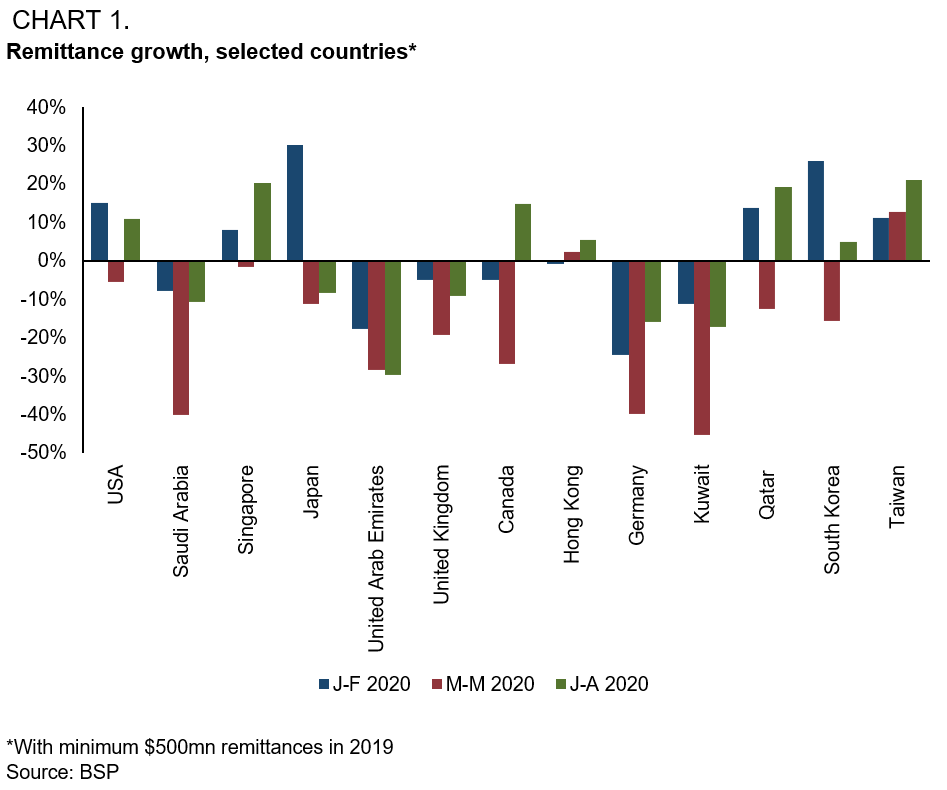
1. Remittances have surprised on the upside. Monies sent home have expectedly declined but not as much as anticipated. After plummeting by double digits in April and May year on year, the inflows rebounded in June and July, each by nearly 8%, then slipped again in August but only by 4%. For the six-month period since the pandemic started (from March to August), remittances fell moderately by 5% year on year, bringing the year to August decline to only 2.6%. This is good news considering that in our last outlook report, we were expecting a 7% contraction for the year. (The ADB and the World Bank forecast double digit drops in remittance inflows earlier in the year.)

What appears to be driving the stronger than expected remittances are inflows from countries that have large Filipino migrant populations (US and Canada) where the respective governments have also provided generous fiscal support, including wage subsidies (e.g., US, Singapore), and/or have managed the outbreak relatively better (e.g., east Asian economies). Too, despite the bust in cruise tourism, remittances from seafarers have also performed better that expected due to improved trade volumes in 3Q.

Nevertheless, there are still significant downside risks moving forward with several host countries facing a resurgence of COVID-19 (including the US and in Europe) that risks keeping unemployment high for longer, and the prospect of continuing low oil prices weighing down oil exporting economies, particularly in the Middle East which host many overseas Filipino workers.

At the same time, remittances may come under renewed pressure as fiscal packages are downsized or withdrawn following sharp increases in public debts, more businesses closing shop especially in the service sector where many overseas Filipino workers, and possible waning of momentum in global trade amidst continuing geopolitical uncertainties. Moreover, despite better than expected dollar remittances, the peso’s over 4% appreciation so far this year reduces the support to domestic consumption.

2. After a dramatic speakership fight at the House of Representatives early this month that provoked a televised presidential rebuke and necessitated the calling of a special session of Congress to pass the 2021 national budget, the Lower House under a new leadership quickly approved the spending bill that is expected to be sent to the Senate today. Considering the President’s certification of the bill as urgent for the government’s continuing struggle against COVID-19, expectations are that a new appropriations law will be ready by the start of next year.

Yet, while the P4.5-trillion (22% of GDP) budget, which is 10% above this year’s approved budget (excluding supplemental funds under the Bayanihan Act), appears on paper to be responsive to the COVID-19 crisis (with proposed spending priorities for health, infrastructure development, and post-pandemic adaptation), a lingering question is how well the executive can implement the plans and programs. Reports indicate failures at the height of the pandemic to distribute allocated social amelioration funds both fully and in a timely way. Also, out of the P140-billion supplemental budget approved in September, the budget department reported that releases have only totaled P4.4 billion with P46.2 billion pending approval of the Office of the President and the remaining P89.4 billion still awaiting requests from the concerned departments. Given fiscal authorities’ relatively conservative stance in the fight against COVID-19, underspending a limited budget would be tragic especially in the face of the pandemic’s disproportionate impact on lower income groups.

3.  Now into the eighth month of varying lockdown stringency, the Philippine government is finally attempting in earnest to open the economy. After flip-flopping last month, it has proceeded to reduce distancing protocols for public transport to maximize the share of the economy allowed to open under the latest guidelines (about 65% per the planning secretary vs. only 50% effectively if those who are allowed to work have no means of getting to work). It has also allowed more age groups to leave homes, reduced curfew hours, and eased tourism restrictions including allowing outbound travel and local hotels to operate at 100% capacity. The decision resulted from a full cabinet meeting early this month and was taken subject to the conditions that everyone observes the minimum health standards and that hospital capacity remains below the 70% threshold (the latest occupancy rate is 52% in Metro Manila).The move to open up the economy is being done at a time when there appears to be some plateauing of the COVID-19 infection curve, with the doubling time lengthening since late August and the reproduction number falling below 1. The caveat however is that since Oct 16, testing has dropped significantly as the Philippine Red Cross (PRC) stopped accepting the state insurance agency’s credit for non-payment of about P1 billion in arrears. Prior to the suspension, the PRC was conducting about a third of the 30,000 tests done on average per day. Too, challenges remain in isolating individuals who have tested positive for the coronavirus as well as in contact tracing, critical functions for successfully suppressing the virus per the experience of other countries. Hence, while it is good news that the government has finally taken the tough decision to “dance” with COVID-19, diligently planning the steps for opening the economy while managing health risks, many harbor lingering concerns about implementation, the Philippine’s Achilles heel.